11 Open Dynamics in QuTiP: The Master Equation
In Chapter 10, we discussed the evolution of closed quantum systems, where the dynamics is governed by the Schrödinger equation. The evolution of the state vector \(\ket{\psi(t)}\) is given by:
\[ \frac{d \ket{\psi(t)}}{dt} = -\frac{i}{\hbar} \hat{H} \ket{\psi(t)} \]
where \(\hat{H}\) is the Hamiltonian operator of the system. The solution to this equation leads to unitary evolution. In contrast to the closed case, open quantum systems interact with their environment, leading to non-unitary evolution described by the Master equation:
\[ \frac{d \hat{\rho}}{dt} = -\frac{i}{\hbar}[\hat{H}, \hat{\rho}] + \sum_k \left( \hat{L}_k \hat{\rho} \hat{L}_k^\dagger - \frac{1}{2} \{\hat{L}_k^\dagger \hat{L}_k, \hat{\rho}\} \right) \]
Here, \(\hat{\rho}\) represents the density matrix of the system, \(\hat{L}_k\) are the Lindblad operators representing different dissipation processes. and \(\{\hat{A}, \hat{B} \} = \hat{A} \hat{B} + \hat{B} \hat{A}\) is the anti-commutator between the operators \(\hat{A}\) and \(\hat{B}\).
11.1 Example: the damped harmonic oscillator
We can use the Master equation to study the dynamics of a damped harmonic oscillator. The Hamiltonian for a harmonic oscillator is given by:
\[ \hat{H} = \omega_0 \hat{a}^\dagger \hat{a} \]
where \(\hat{a}\) and \(\hat{a}^\dagger\) are the annihilation and creation operators, respectively, and \(\omega_0\) is the angular frequency of the oscillator.
To model the damping, we can introduce a Lindblad operator that represents the interaction with the environment. In the case of the interaction with a zero-temperature bath, the Lindblad operator can be defined as:
\[ \hat{L} = \sqrt{\gamma} \hat{a} \]
where \(\gamma\) is the damping rate. Let’s now initialize the system in a coherent state and evolve it using the Master equation. We will also visualize the evolution of the position and energy expectation values over time.
11.1.1 Plotting the results
import matplotlib.pyplot as plt

# Plot the expectation values
fig, ax = plt.subplots()

ax.plot(tlist, result.expect[0], label=r"Energy $\langle \hat{H} \rangle$")
ax.plot(tlist, result.expect[1].real, label=r"Position $\langle \hat{x} \rangle$")
ax.set_xlabel(r"Time $t$")
ax.set_ylabel("Expectation values")
ax.legend()
ax.set_title("Damped Harmonic Oscillator Dynamics")

# Show in Quarto
plt.savefig("_tmp_fig.svg")
plt.close()
SVG("_tmp_fig.svg")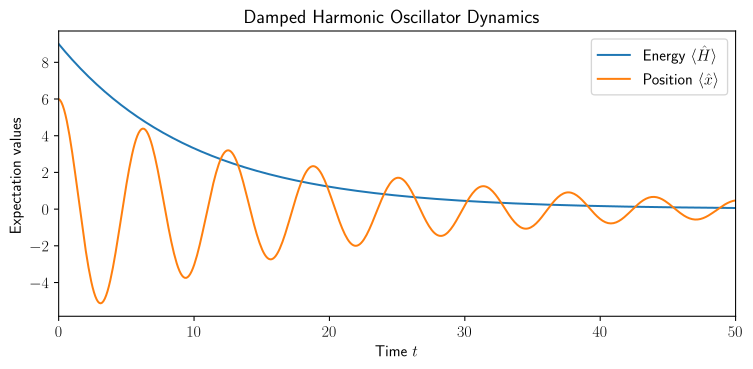
11.2 Time-dependent parameters: the case of logical quantum gates
In classical computing, logical gates such as AND, OR, and NOT process bits (0 or 1) to perform basic operations. For example:
- AND outputs 1 only if both inputs are 1.
- OR outputs 1 if at least one input is 1.
- NOT inverts its input bit.
These gates form the building blocks of all classical algorithms and digital circuits.
Quantum computing generalizes this idea by using qubits, which can exist in superpositions of 0 and 1. Quantum gates act on these superposed states via time-dependent Hamiltonians, enabling phenomena like entanglement and interference. This richer behaviour unlocks powerful algorithms (e.g., Shor’s factoring, Grover’s search) that have no efficient classical equivalent.
As an example, we consider a combination of gates that generates a bell state
\[ | \Phi^+ \rangle = \frac{1}{\sqrt{2}} (| 00 \rangle + | 11 \rangle). \tag{11.1}\]
To achieve this, we can use a sequence of quantum gates:
- Hadamard gate: Applies a Hadamard gate to the first qubit, transforming \(| 0 \rangle\) into \(\frac{1}{\sqrt{2}} (| 0 \rangle + | 1 \rangle)\).
- CNOT gate: Applies a controlled-NOT gate, where the first qubit controls the second. This flips the second qubit if the first is in state \(| 1 \rangle\).
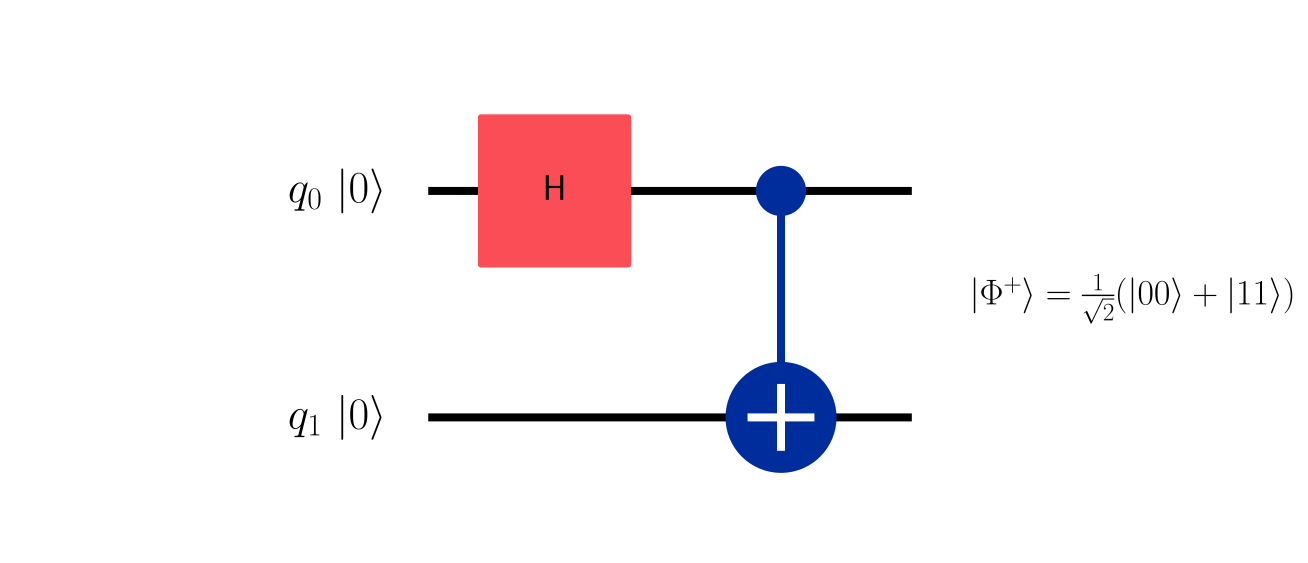
Each gate can be represented by a time-dependent Hamiltonian. For example, the Hadamard gate can be implemented using a Hamiltonian
\[ \hat{H}_\mathrm{H}^{(1)} (t_0, t) = \Theta (t - t_0) \Theta ( t_0 + \pi / 2 - t) \frac{1}{\sqrt{2}} \left( \hat{\sigma}_x^{(1)} - \hat{\sigma}_z^{(1)} \right) \]
where \(\Theta(t)\) is the Heaviside step function, and \(\hat{\sigma}_x^{(1)}\) and \(\hat{\sigma}_z^{(1)}\) are the Pauli operators acting on the first qubit. The Heaviside function ensures that the Hamiltonian is non-zero only during the time interval \([t_0, t_0 + \pi / 2]\), where \(t_0\) is the time at which the gate is applied.
The CNOT gate can be implemented using a Hamiltonian that couples the two qubits
\[ \hat{H}_\mathrm{CNOT} (t_0, t) = \Theta (t - t_0) \Theta ( t_0 + \pi / 2 - t) \ \left(\hat{\mathbb{1}} + \hat{\sigma}_z^{(1)} \right) \otimes \left( \hat{\mathbb{1}} - \hat{\sigma}_x^{(2)} \right) \]
where \(\hat{\sigma}_x^{(2)}\) acts on the second qubit, and \(\hat{\mathbb{1}}\) is the identity operator. The Heaviside function again ensures that the Hamiltonian is non-zero only during the time interval \([t_0, t_0 + \pi / 2]\).
In absence of losses, the output state after applying these gates is exactly the Bell state \(|\Phi^+\rangle\) defined in Equation 11.1. However, in a realistic scenario, we need to account for the effects of decoherence and dissipation, which can be modeled using the Master equation. This poses a challenge for quantum computing, as the coherence of the qubits must be maintained during the gate operations to ensure the correct output state.
To simulate the effects of decoherence, we consider the case where the qubits are in interaction with a finite-temperature environment, which can lead to energy dissipation and dephasing. In this case, the Master equation can be used to describe the dynamics of the system. We can introduce a Lindblad operator that represents the interaction with the environment. For example, we can use a Lindblad operator that describes the decay of the qubits:
\[\begin{align*} \hat{L}_1 &= \sqrt{\gamma (n_\mathrm{th} + 1)} \hat{\sigma}_-^{(1)}, \quad \hat{L}_2 = \sqrt{\gamma (n_\mathrm{th} + 1)} \hat{\sigma}_-^{(2)} \\ \hat{L}_3 &= \sqrt{\gamma n_\mathrm{th}} \hat{\sigma}_+^{(1)}, \quad \hat{L}_4 = \sqrt{\gamma n_\mathrm{th}} \hat{\sigma}_+^{(2)} \end{align*}\]
where \(\hat{\sigma}_+^{(i)}\) and \(\hat{\sigma}_-^{(i)}\) are the raising and lowering operators for the \(i\)-th qubit, respectively, \(n_\mathrm{th}\) is the average number of thermal excitations in the environment, and \(\gamma\) is the decay rate. The Lindblad operators describe both energy dissipation (via \(\hat{\sigma}_-\)) and thermal excitation (via \(\hat{\sigma}_+\)) of the qubits.
We can use the ability of QuTiP to define time-dependent Hamiltonians to simulate the evolution of the system under the influence of these gates and the Lindblad operators.
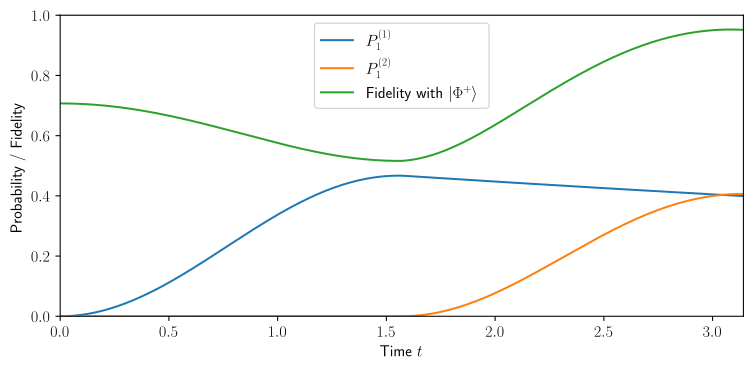
We now plot the following quantities as a function of time:
- The probability of finding the first qubit in state \(| 1 \rangle\).
- The probability of finding the second qubit in state \(| 1 \rangle\).
- The fidelity with the target Bell state \(|\Phi^+\rangle\).
# Bell state
bell_state = (tensor(basis(2, 0), basis(2, 0)) + tensor(basis(2, 1), basis(2, 1))).unit()

P0_1 = expect(sm1.dag() * sm1, result.states)
P0_2 = expect(sm2.dag() * sm2, result.states)
fid = [fidelity(bell_state, s) for s in result.states]

fig, ax = plt.subplots()

ax.plot(tlist, P0_1, label=r"$P_1^{(1)}$")
ax.plot(tlist, P0_2, label=r"$P_1^{(2)}$")
ax.plot(tlist, fid, label=r"Fidelity with $|\Phi^+\rangle$")
ax.set_xlabel(r"Time $t$")
ax.set_ylabel("Probability / Fidelity")
ax.set_ylim(0, 1)
ax.legend()

# Show in Quarto
plt.savefig("_tmp_fig.svg")
plt.close()
SVG("_tmp_fig.svg")