import numpy as np
import matplotlib.pyplot as plt
from qutip import *

# Parameters
wc    = 5.0   # cavity
wq    = 5.0   # atom (on resonance)
g     = 0.1   # coupling
kappa = 0.03  # cavity decay
gamma = 0.00  # atomic T1 (suppressed)
n_th  = 0.01  # thermal photons of the environment
N     = 20    # Fock cutoff

# Operators
a  = tensor(destroy(N), qeye(2))
sp = tensor(qeye(N), sigmap())
sm = tensor(qeye(N), sigmam())
sz = tensor(qeye(N), sigmaz())

H = wc * a.dag() * a + 0.5*wq * sz + g * (a.dag() * sm + a * sp)

# Dissipators
c_ops = [np.sqrt(kappa * (n_th + 1)) * a, np.sqrt(gamma * (n_th + 1)) * sm,
np.sqrt(kappa * n_th) * a.dag(), np.sqrt(gamma * n_th) * sp]14 The Emission Spectrum of the Jaynes–Cummings Model
In Chapter 12, we introduced the Jaynes–Cummings (JC) model as a cornerstone of quantum optics and cavity QED. Here we focus on the emission spectrum of the JC system, exploring how the interaction between a single atom and a single cavity mode manifests in the frequency domain. We will see how the spectral lines reflect the dressed–state structure of the system and how dissipation modifies this picture.
14.1 Analytic Analysis
Under the condition of zero detuning \(\Delta = \omega_c - \omega_q = 0\), the Jaynes–Cummings dressed‐state energies simplify. For the \(n\)-th excitation manifold, the two eigenvalues become:
\[ E_{n,\pm} = n\,\omega_c \pm g \sqrt{n+1} \,. \]
Here:
- \(\omega_c\) is the cavity frequency.
- \(g\) is the single‐photon coupling strength.
- \(n = 0,1,2,\dots\) counts the total number of excitations shared between atom and field.
Whenever the system loses a photon, it jumps from the \(n\)-th manifold down to the \((n-1)\)-th. Each of the two states at level \(n\) (\(E_{n,+}\) or \(E_{n,-}\)) can decay into either of the two states at level \(n-1\). Concretely, the four allowed decay channels are:
- \(E_{n,+} \to E_{n-1,+}\)
- \(E_{n,+} \to E_{n-1,-}\)
- \(E_{n,-} \to E_{n-1,+}\)
- \(E_{n,-} \to E_{n-1,-}\)
Each channel corresponds to a distinct emission line in the spectrum, with its frequency given by the energy difference between initial and final states.
14.1.1 Case of Small Population
When the system is weakly excited, it rarely climbs above the first excitation manifold. Practically, only \(n=0\) (the vacuum) and \(n=1\) are occupied. In this regime:
Manifolds populated: Only \(n=0\) and \(n=1\).
Transitions: From \(E_{1,+}\) and \(E_{1,-}\) down to the vacuum at \(E_{0}=0\).
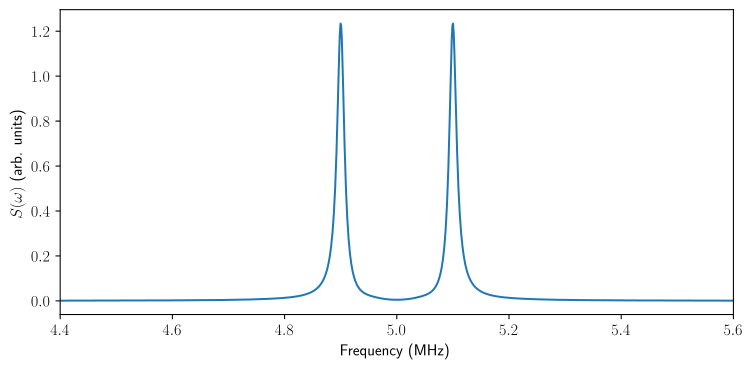
Observed lines: Exactly two, located at:
\[ \omega = \omega_c \pm g \]
These two peaks form the well‐known vacuum Rabi splitting. As soon as you start populating higher manifolds, the spectrum becomes richer, with more lines appearing at frequencies \(\omega_c \pm g(\sqrt{n+1} \pm \sqrt{n})\) for \(n=0,1,2,\dots\).
14.2 Numerical simulation with QuTiP
We now simulate the emission spectrum of the JC model using QuTiP, focusing on the weak and strong coupling regimes. We will compute the emission spectrum \(S (\omega)\) of the cavity field using the spectrum function. We first define the system and its parameters.
And we finally compute the emission spectrum.